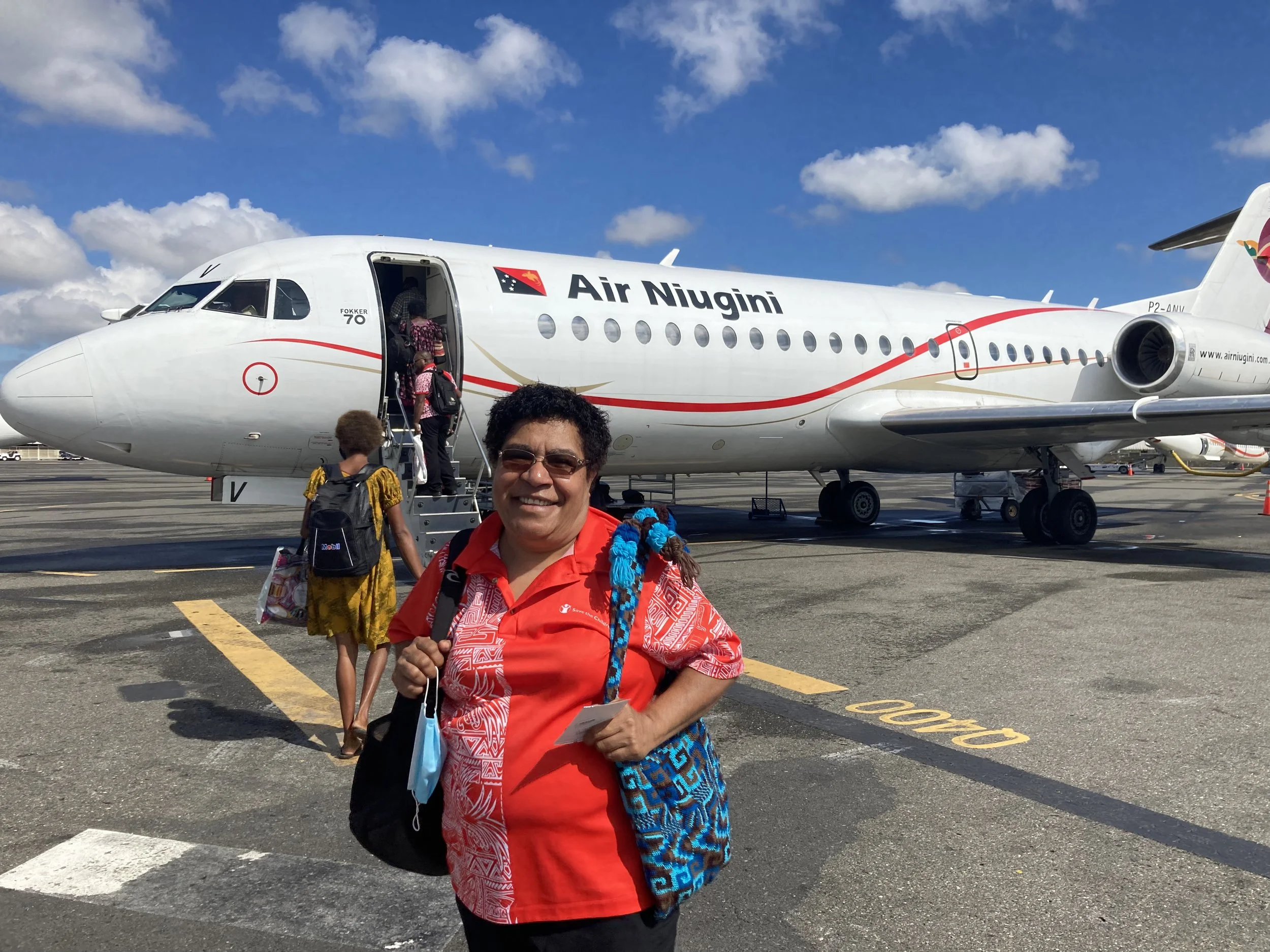
Lydia Seta - A Pioneer | 2024
I have known Lydia Seta now for seven years. She is a kind, honest, loyal, secretly goofy, woman of faith from the Highlands of Papua New Guinea with a green thumb.
She likes to play card games, has a very strong sense of right and wrong, and is the work mother and counsellor for everyone who needs a listening ear, a prayer, or word of encouragement.
You know Lydia has had a stressful day when her hair is all messy and you can almost see the imprint her hand has left in her hair.
She taught me to pot my first set of plants, gave me the confidence to grow flowers, and inspects the health of my garden whenever she visits. This is her story.
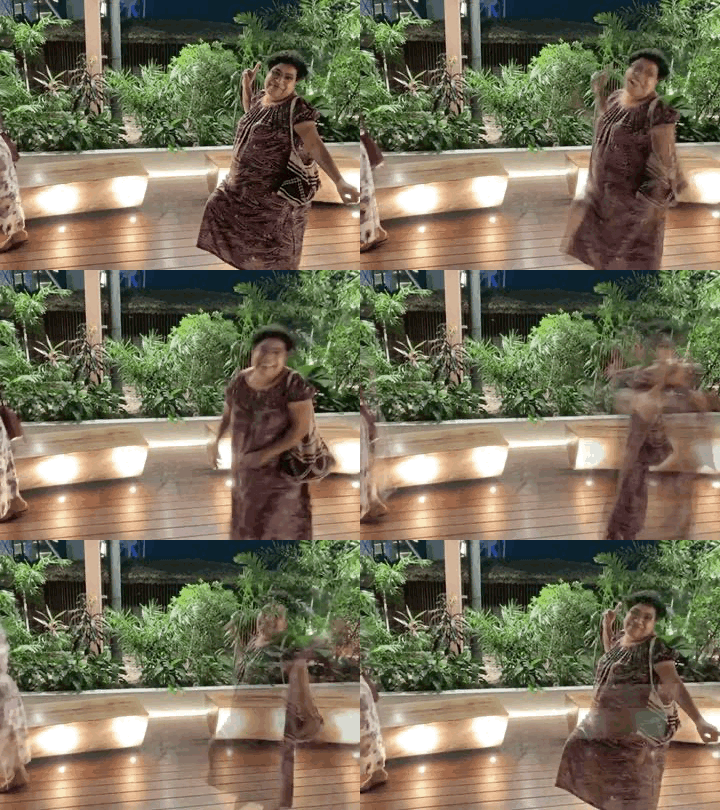
Lydia tapping into her goofy self.
I grew up in two places, Nukumar Village and Kungunung village in Jiwaka Province in the 1970s (when it was still called Western Highlands) around the time of Papua New Guinea’s independence from Australia. My grandfather had land in both places so we would walk the hour back and forth between the two. I had older cousins in Nukumar that I would play with all day long.
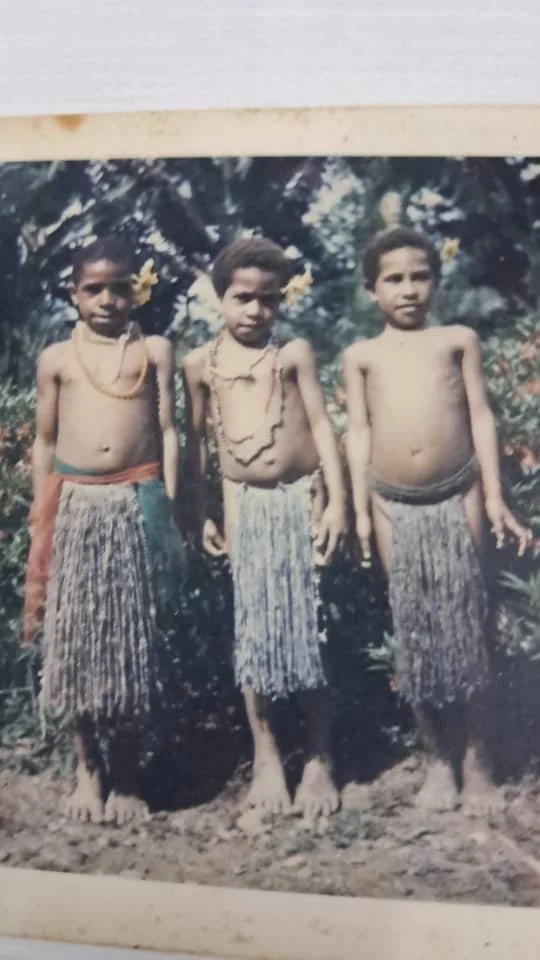
Lydia, in the centre, dressed up for Traditional Days every Monday at school in the 1970s.
My world was shaped by what I saw around me. In my village, women would look after children, tend to their gardens, and sell goods at the market. Naturally, the games we played revolved around that.
With my cousins and friends, we would often find small bilums (woven bag made of natural fibres), pick leaves off the ground, stuff them in our bilums and visit different mothers in my village pretending to sell my market goods. I also enjoyed breaking the big heavy flowers from the banana trees and play with them like baby dolls, rocking them and taking care of them like a good mother would.
I also had a reputation for being the best marble player in my village, which was a fact. The marbles we had were made of tightly rolled up reeds. Sometimes, one of the children would come across real marbles. Whenever someone wanted to play, the children would call for me and I would bolt out of my house with my bilum full of marbles and play to win. I knew I was the best and I let them know it.
I had an uncle named Kuk who doted on me. I loved being his favourite niece. When he was around, I felt very special. He would take me on trips to the river and just let me play freely. Unfortunately, the time came for my uncle to get married. He meet a woman named Flour and they tied the knot. Once Uncle Kuk started having his own children, he didn’t have as much time for me and I was beside myself with jealousy. He had three children named Peter, Annie, and Mai. I didn’t know how to express my jealousy at such a young age and would sometimes climb up to a cliff with my friends overlooking my Uncle’s house to see the family below. When I saw the children out in the yard, I would taunt them with my friends singing their name in a mean way - “Peter Kuk Mai Annie Flour” and promptly run away. It took a little while for me to get over it and adjust to this new status quo, but when I did, I was off on my next adventure.
One day, when I was about five or six, my cousins were asked to go to school. There was a school a few kilometres through the bush that just opened and they were looking for students. I was so excited for school. I couldn’t wait to join my cousins. When the first day of school arrived, I didn’t tell my parents and ran off with my cousins, walking along the stream for about 40 minutes before reaching the modest building made with bush materials that had a very strict teacher in it. Children from three neighbouring villages were asked to attend that school and it was full of children with nervous excited energy.
The teacher asked all the students to stand in a row and one by one, she got each of them to raise their right arm, put it over their head and touch their left ear. If they were able to do that, the teacher said they were old enough to start school. I was suddenly struck by worry and fear. I was younger than my cousins. They were taller than me and had longer arms. I remember there being about 20 students in front of me and all of them had been able to touch their left ear. My cousins who were standing just ahead of me managed to do it easily. When it came to my turn, I raised my right hand, put it over my head and strained. I pushed and moved my arm around, but try as I might, I couldn’t touch my left ear. The teacher looked sympathetically at me and said “Sori, yu go lo haus” (Sorry, you have to go back home). I hung my head so low it could have dragged on the floor. I was so embarrassed that I couldn’t look up at my cousins and ran out of the school as fast as I could.
Once outside I burst into tears and wailed loudly most of the way home. As I walked along the stream back to my village, I kicked stones into the stream and when I felt my most dramatic, threw myself onto the ground, rolled around and kicked my legs in frustration to blow off some steam. Once I felt better, I got up, dusted myself off, but continued to sulk. Closer to the village I saw one of my neighbours, a girl my age, waiting for her mother to finish up in their garden. Her mom was collecting garden kaikai (food) for dinner. I walked towards the girl and we both started playing. We had so much fun together that I soon forgot all about what happened at school.
In the late afternoon, when I was home, I heard my cousins talking excitedly about their first day of. All my feelings of shame and resentment came welling up in me and I hid inside my house refusing to see my cousins that day. I wasn’t a little girl who could really hold a grudge no matter how hard I tried, so everything went back to normal soon after that.
The next year, I went back to that same school and confidently touched my left ear with my right hand over my head. I was ready for school this time. The year was 1975.
I proved to be a star student. Diligent, honest, hardworking, and intelligent. Before I knew it, the years passed and I joined the Kudgjip Nursing College in 1986 in Western Highlands (now Jiwaka) province.
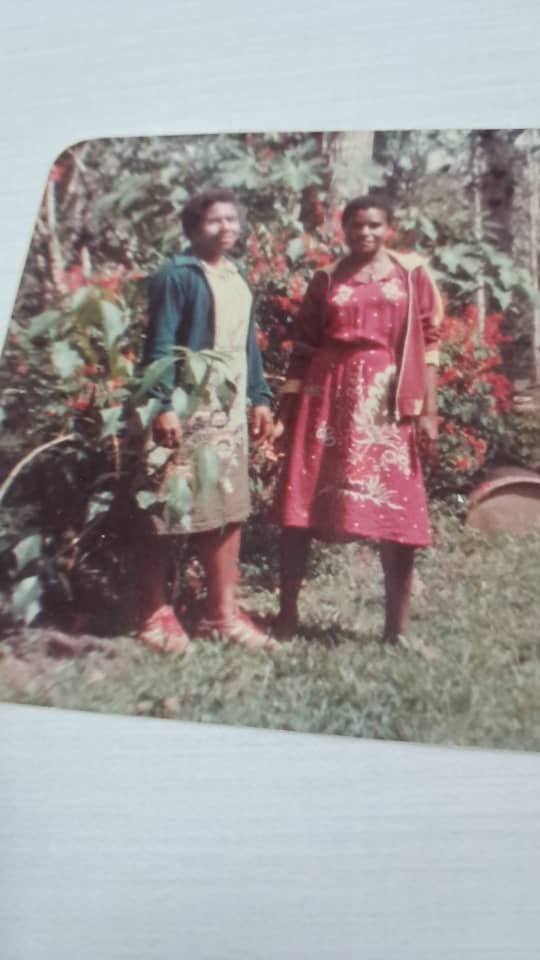
Lydia on the left in green during her high school days.
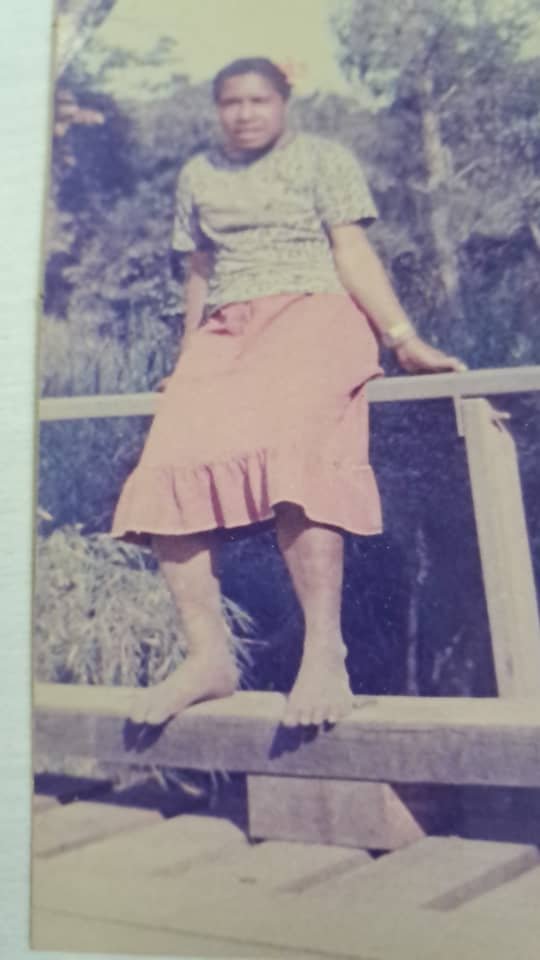
Lydia during school holidays in high school.
I had many friends in nursing college, young girls like me who moved from their villages to the towns to work hard for a better life for us and our families.
In our second year of nursing in 1988, all the students had to perform our practicum at Kudjip Nazarene Hospital. We would practice taking vitals, giving injections, inserting IV drips, and drawing blood, all the routine tasks of a nurse. One day, a young man was admitted to the hospital with symptoms of chills, fever, and nausea. He was a Jiwaka man from Banz who became a soldier with the Australian Armed Forces and travelled the world. He was very suave and charming. When he wasn’t sick, you could bet that he was flirting with the nurses. My friend really took a liking to him and started to get quite cosy. They even made plans to be together after he was discharged from the hospital.
The man spent weeks at the hospital, but the doctors were still not able to diagnose what he had. His periods of lucidity were decreasing and his symptoms were becoming stronger. He also started hallucinating.
One day, I was asked to draw blood from him as part of a routine check. I did this without any gloves, which was common practice back then. I went in by myself and told the man I was going to take his blood. He was calm and agreed. While I was inserting the needle into his arm, he was suddenly gripped by a hallucination and started flailing about. Mind you, he was a former soldier and therefore a big strong man. The tubes already attached to him were breaking off one by one. I tried to restrain him and shouted for help. His blood was flying everywhere and got all over my hands before the attending doctors and nurses could help me. He created a huge mess. When his hallucination was finally over, he fell into a deep sleep.
I was in shock as you can imagine. I took off my uniform and washed myself several times to get the feeling of blood off me, especially my hands. Then, I went back to work as normal. No one gave it a second thought. Two weeks later, the man’s blood sample from Australia came back and it turned out he had HIV. He was the first man to have been diagnosed with HIV in Papua New Guinea, suspected of having contracted it while on duty overseas. When the hospital found out the patient was HIV+, they were really scared. There was so little information about how it spread except that it was transmitted through blood. They bleached all their equipment and threw out all consumables he touched.
But I had his blood on me. I was petrified. I had to send my blood sample to Port Moresby, our capital city, to find out if I had contracted it. Waiting for the results were some of the longest weeks of my life. I felt so tormented, I thought I was going to die. I couldn’t eat or sleep or think of anything else. I just prayed and prayed all day and night.
To my great relief and by the grace of God, the test came back negative. I was HIV -. I started back at work again and a few weeks after, the man passed away. Due to the relations he had with women in town before he was admitted, HIV spread in PNG from then on.
I eventually graduated from nursing college and continued working as a nurse at Kudjip Nazarene Hospital for three years before moving to Mt. Hagen Hospital for 12 years in Western Highlands Province. In 2007, after 15 years of nursing, I found an opportunity to work with Save the Children on the Poro Sapot Project in Port Moresby, a HIV and sexual reproductive health (SRH) programme. By this time I had married a very nice man from Milne Bay who worked for a helicopter company in Mt. Hagen and we had three children together, two boys and a girl. We all moved to Port Moresby for my job and I formed a new social life by being active in my church community and keeping up my hobby of gardening and flower arranging.
I loved my job working with marginalised communities - sex workers, transgenders, men who had sex with men (being gay is illegal in PNG). I found it very fulfilling to promote prevention of HIV; increase access to counseling, testing, and treatment services; and strengthen community and government systems to manage the HIV response. While there were successes, it was also a heartbreaking job. Patients I’d see come in, who started off strong on their treatment programme, would face a lapse and eventually pass away. Even those who had overcome their challenges enough to bring others into the program, would also get sicker and eventually pass away. So many good people in troubled circumstances that I grew to love through the program passed on.
I was with that program for 10 years and at one point worked at one of the mobile clinics doing HIV testing. I had a fever the day before one of my shifts and was really feeling unwell, but I knew that if I didn’t go in, the mobile clinic wouldn’t open so I decided to power through. The clinic opened at the usual time of 8am and I started to see patients. As the day wore on, I grew weaker and a little more disoriented. A patient came in for an HIV test. I put on my gloves and pricked the patient, collected the blood sample then felt faint all of a sudden. I took a step back and accidentally pricked myself with the needle I had just used on the patient. I froze. All my memories from the previous experience with HIV came back. I panicked.
I didn’t remember how the patient left or how I closed up the mobile clinic that day, but I was gripped with a feverish panic. The trauma from all those years ago came flooding back and I found myself having a nervous breakdown. I was inconsolable - crying and screaming at home and for a month. I turned my whole house upside down with grief and fear. Even after my HIV test came back negative, I didn’t believe it and continued spiralling into madness. My children were so afraid and my husband was at a loss of what to do. Through Save the Children, I was able to seek counselling in Sydney, Australia. I stayed there for two weeks before I got better and came back to PNG.
I really believe it was by God’s grace that I was able to come back to my senses and continue living with good health.
I would face other health scares in life, but nothing I haven’t overcome. I now work for Fred Hollows Foundation, focusing on eye health and access to much needed eye care services in Papua New Guinea. My husband works as hard as I do for another helicopter company. One of my sons went to China for university and graduated with a petroleum degree. My daughter works in a Bank and my other son works in an architectural firm.
Lydia is a “powa meri” (strong woman) who came of age along with PNG’s independence. She has lived a story of resilience, faith, and overcoming and I am so proud to call her a dear friend of mine.